
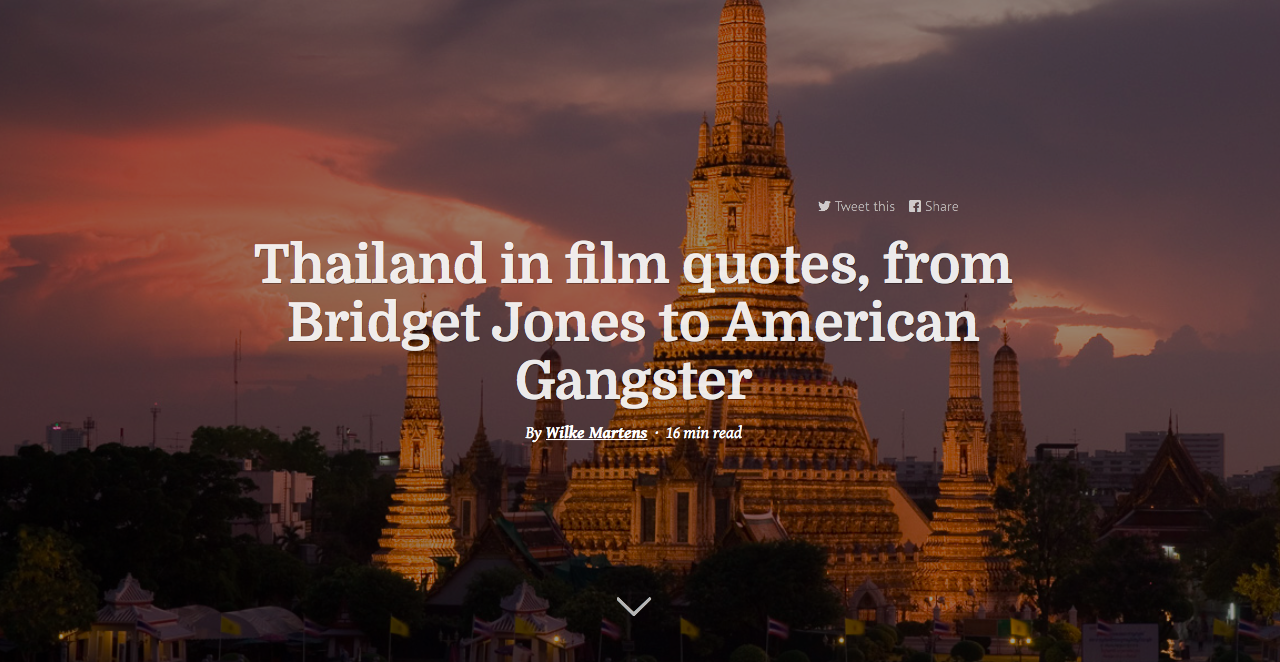
Dozens of Hollywood movies have been recorded – or are set – in Thailand. And for a good reason: this Southeast Asian country boasts bustling cities, white sandy beaches and dramatic mountain scenery. This journey takes you to the highlights of Thailand, in six film quotes.
“Arrived Bangkok, very hot. Relieved at last to throw myself into serious journalistic work.” Bright pink and yellow ribbons are tied around a huge tree trunk. In tiny altars food and drinks are being offered to the gods. The trees are cheerfully decorated with red lanterns. A bit further down the alley an oldtimer Mini is rusting away. ‘There’s no time to stop,’ Piyawat says, the guide, as he zigzags his way through two hundred year old Chinatown. If only I can keep up with him, getting lost in this city of millions is the last thing I need. Piyawat disappears behind the next corner, before he enters a building. I follow him, up the stairs, all the way to the rooftop. ‘Just in time for a sunset beer’, he grins when we arrive on the rooftop terrace. He points at the beautiful view over Bangkok, the bright red sun is about to go down. We sit down with an ice-cold Singha. On this hot day, with a beautiful view over Bangkok, this is the perfect introduction to Thailand.
But, as much as Bridget Jones in The Edge of Reason, I’m here to do serious journalistic work. The next few days I will be discovering the highlights of Thailand – both in and around Bangkok, as well as up north in Chiang Mai, the largest city of the region. But first I’m about to go on a cultural and culinary discovery of Bangkok’s Chinatown. Piyawat is guiding me through the now dark maze of alleyways. Still, it doesn’t take long before we arrive again in the hustle and bustle of the neon lit streets. On both sides of the road, food vendors are stir-frying, barbecuing and grilling on open fires, not minding the traffic that is still making its way through the neighbourhood. On one corner of the street, dim sum is cooked in enormous stainless steel pots, while on another corner a young man is selling purple pomegranate juice. The local crowd is swarming in between all these stalls, looking for their favourite snacks. There’s nothing left for me to do on this first day in Bangkok, but to follow their example.
Mayhem in the Grand Palace
‘Ni hao.’ The Thai security guard greets me in Mandarin, while I’m shambling in between hoards of Chinese towards the entrance of the Grand Palace in Bangkok to have my ticket checked. Nowadays western travellers are not the most important group of tourists for Thailand anymore. While trying to avoid selfie sticks and parasols, I follow Piyawat to Wat Phra Kaew, the temple with the famous Emerald Buddha. It seems as if all visitors are gathering here today, despite the fact that the palace complex is enormous. ‘It’s impossible to go in right now,’ Piyawat explains. ‘There are important people in the temple to pray, which means visitors cannot enter.’ Luckily the doors are still open, so I can get a glimpse of the tiny, but centuries old Buddha, that has arrived in Bangkok after several wars with the Burmese. The Buddha most likely originated from the north of Thailand and has been taken to temples in Chiang Rai and Lampang, before moving to Vientiane, the current capital of Laos. There it remained for 214 years, before it was finally taken to Bangkok by the end of the eighteenth century. This Buddha, I realize, has probably seen more of Southeast Asia than most people who worship it.
‘You know’, Piyawat interrupts my thoughts, ‘this Buddha is very fashionable.’ He buys a set of postcards at one of the stalls. ‘There’s a different outfit for every season.’ He shows me the cards, with the Emerald Buddha in an elegant golden outfit for the dry season. In rainy season the Buddha wears a gold-embossed monk’s robe, to which a golden shawl and headpiece is added in winter. It appears not the to be the only amusing thing about the Grand Palace. ‘The paintings on the wall tell the story of Rama, the Hindu god, but the story is adjusted to Thai Buddhist culture,’ Piyawat explains as we walk along the incredibly detailed hand-painted walls. ‘That’s why the artists have hidden some jokes in the paintings.’ Piyawat points at one particular part of the wall painting: the depiction of a gate, with only one guard keeping watch. ‘There always have to be two guards at a gate,’ he says, grinning already. ‘But look, here’s the other one, in the bushes fooling around with a girl.’
I will give you 20,000 Baht if you can make this heap go any faster – James Bond in The Man with the Golden Gun
‘Welcome on board the James Bond boat.’ Piyawat is trying to be funny as ever, while we are getting ready for a boat trip on the so-called khlongs, the canals of Bangkok. As soon as we are seated, the boat driver steers away the long tail boat as fast as he can. It seems he really got paid 20.000 baht (about 500 euros), he’s racing that fast on the canals. ‘Ever since The Man with the Golden Gun was filmed here, these long tail boats are called by their new name.’ Piyawat is shouting to make himself heard over the engine noise. Surprisingly, there’s a monitor lizard warming up on a wooden jetty, undisturbed by all the noise from passing ‘Roger Moores’.
The boatman ties up at Khlong Bang Luang, an artists’ village on the canals. The modern art that is made, exhibited and sold here is in sharp contrast with the centuries old houses. It’s busy at the artist village, where both Thai and tourists alike are gathering at Baan Silapin. Any moment a traditional puppet show can start, but luckily there’s some time left for a massaman curry: a simple but oh so delicious Thai curry with chicken, potato, carrot, onion and peanuts. With a full stomach I’m squeezing in between the crowd, just in time before the show starts. Actors dressed fully in black (so all the attention is on their puppets) mimic the story of Hanuman, the monkey-shaped Hindu god. Hanuman is caught in a severe battle to save king Rama’s wife from terrifying demons. The children in the crowd are watching intensely, their mouths open. Compared to this fierce monkey-god, James Bond is nothing…
It’s such a solid, well designed job. Not like the temporary bridges the enemy usually throws together – Bridge over the river Kwai
The solid bridge, supported by massive concrete pillars, is towering above the Khwae Yai River. In between the large steal arches there is a railway, still in use. Piyawat is humming the famous march from the movie, but soon his humming is drowned out by the cheesy ballads that resonate over the square. A street hawker tries to attract customers with loud western ballads, of which he’s selling copies in his stall. Most visitors, though, are too busy taking pictures of the famous bridge over the river Kwai. ‘Back in the days there was a wooden bridge as well,’ says Piyawat. ‘It was located a bit further downstream. Both bridges have been bombed during the Second World War, but this one is still standing. It was heavily damaged during the war, but it never was completely demolished as it was in the film.’
In the Thailand-Burma Railway Centre it turns out the film contains several other historical inaccuracies. The exhibition shows the painful truth behind the Birma railway, which was supposed to connect Bangkok with the former Birmese capital Rangoon. Hundreds of thousands of Asian workers and thousands of Prisoners of War were forced to work on the railway that would run for 415 kilometres through inhospitable land. Due to a lack of food and medical facilities, as well as unimaginably tough labour and the unforgiving climate, thousands of people died. A small tin box, in which a Prisoner of War from a small town in the Netherlands, had engraved a message to his family, is just one of the sad reminders of this dark history.
Different culture, different world. You will fight the ancient way – The Kickboxer
The towers of the old temple ruins stand out against the red, setting sun. Jean-Claude van Damme is on the edge of one of these ruins, in fighting stance. He is in the movie Kickboxer, at least, because the temple ruins of the former kingdom Ayutthaya are a popular setting for martial arts movies. But this World Heritage site was not just the setting for fictional fights: by the end of the 18th century there was a heavy war fought with the Burmese. ‘The Thai army succumbed to Burmese forces and the city was destroyed completely,’ Piyawat says. We stroll along the demolished stupa’s and damaged Buddha statues. Slowly nature is taking over the old city again: between the thick roots of a bodhi tree nothing but Buddha’s head is left of what once must have been an impressive statue.
Chiang Mai
It’s not more than a thirty-minute drive from Chiang Mai, the largest city in Northern Thailand, to reach the jungle. But unlike Frank Lucas in American Gangster, I’m staying far away from poppy fields and opium. Chiang Mai, where the film was partially shot, is the ideal base to discover the Thai countryside. And, as being Dutch, what better way is there to discover the countryside than by bicycle? ‘We’re not yet really used to cyclists,’ says guide Wanna, before we hit the road. ‘So please keep on the left, because we drive on that side of the road in Thailand!’
No. This is the jungle. Tigers. Vietcong. The fuckin’ snakes alone will kill you – Frank Lucas in American Gangster
Even though the hotel is near the centre of Chiang Mai, it doesn’t take long before we reach small country roads. The streets are already crowded, although we’d left not long after sunrise. Merchants are already opening their tiny shops, monks are sweeping the monastery patio’s and farmers are on their way to the rice fields. It’s difficult to imagine we only just left Chiang Mai behind. ‘Slowly, watch out!’, Wanna shouts as we change the tarmac for small dirt roads. We pass an old leper colony, rice fields and fruit orchards. But again, it is an archaeological site that leaves a deep impression during this cycling trip. About ten kilometres from Chiang Mai ruins of the old town can be found. ‘Wiang Kum Kan was discovered only 45 years ago, when new houses were being built in this area,’ Wanna says. ‘Archaeologists found out this city was flooded about seven hundred years ago, which made it no longer inhabitable. The king decided to build a new city: Chiang Mai literally means ‘new city’. When the water withdrew after the flood, the old city was completely covered in mud. People seemed to have forgotten about it, until it was rediscovered a few decades ago.’
‘What other archaeological treasures would be hidden in this country?’, I ask myself when I’m watching Alexander on my laptop in the night train from Chiang Mai back to Bangkok. A train employee arrives to turn the seats into beds. I have already seen so many things on this trip, but it was just a fraction of this enormous country. As the train passes mountains and valleys, I become more aware of the size of this country. But as the dusk sets in, it’s difficult to discern the details in the landscape, until it is completely absorbed by darkness. In a few years time, I decide, I will return.